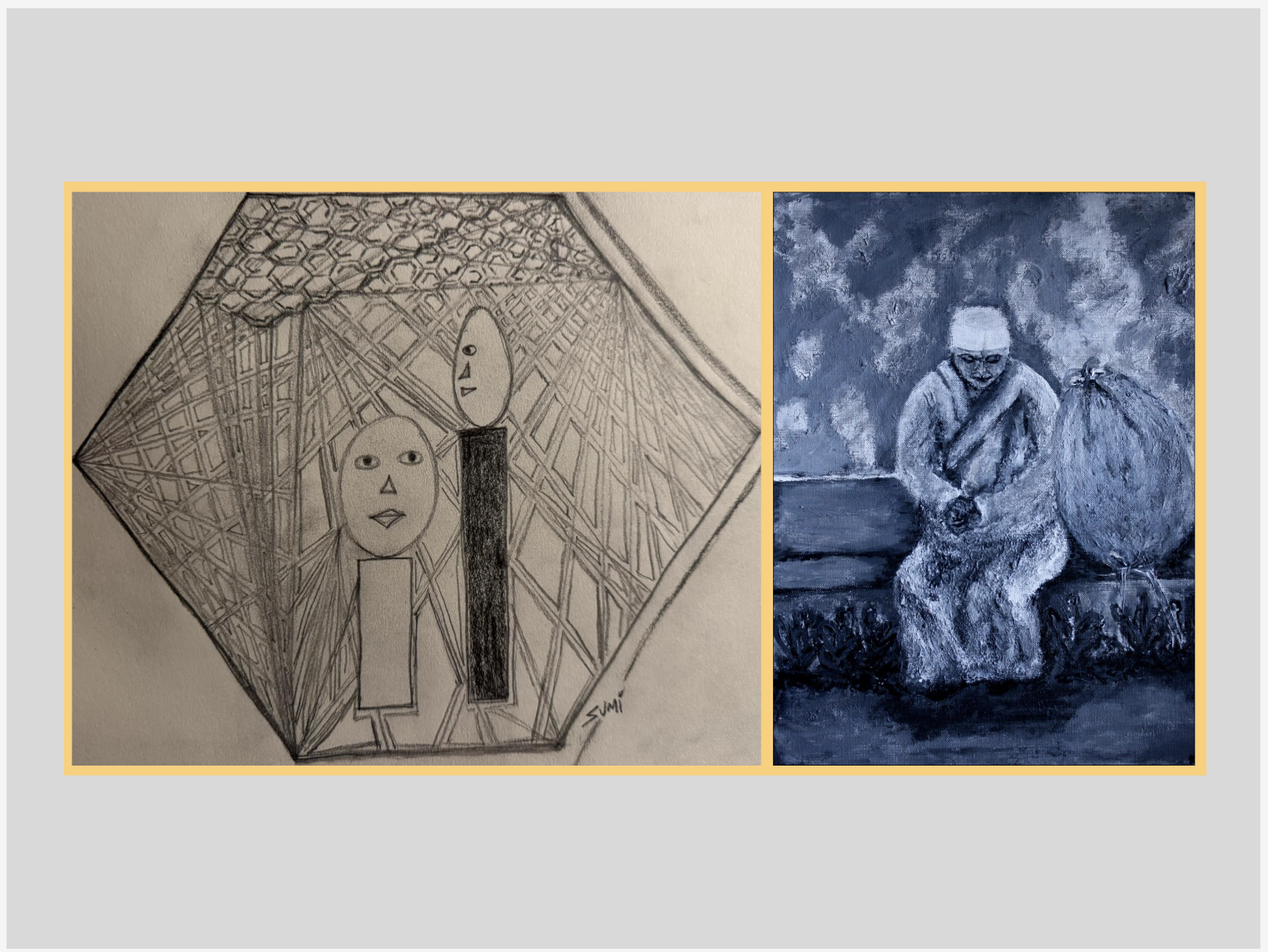
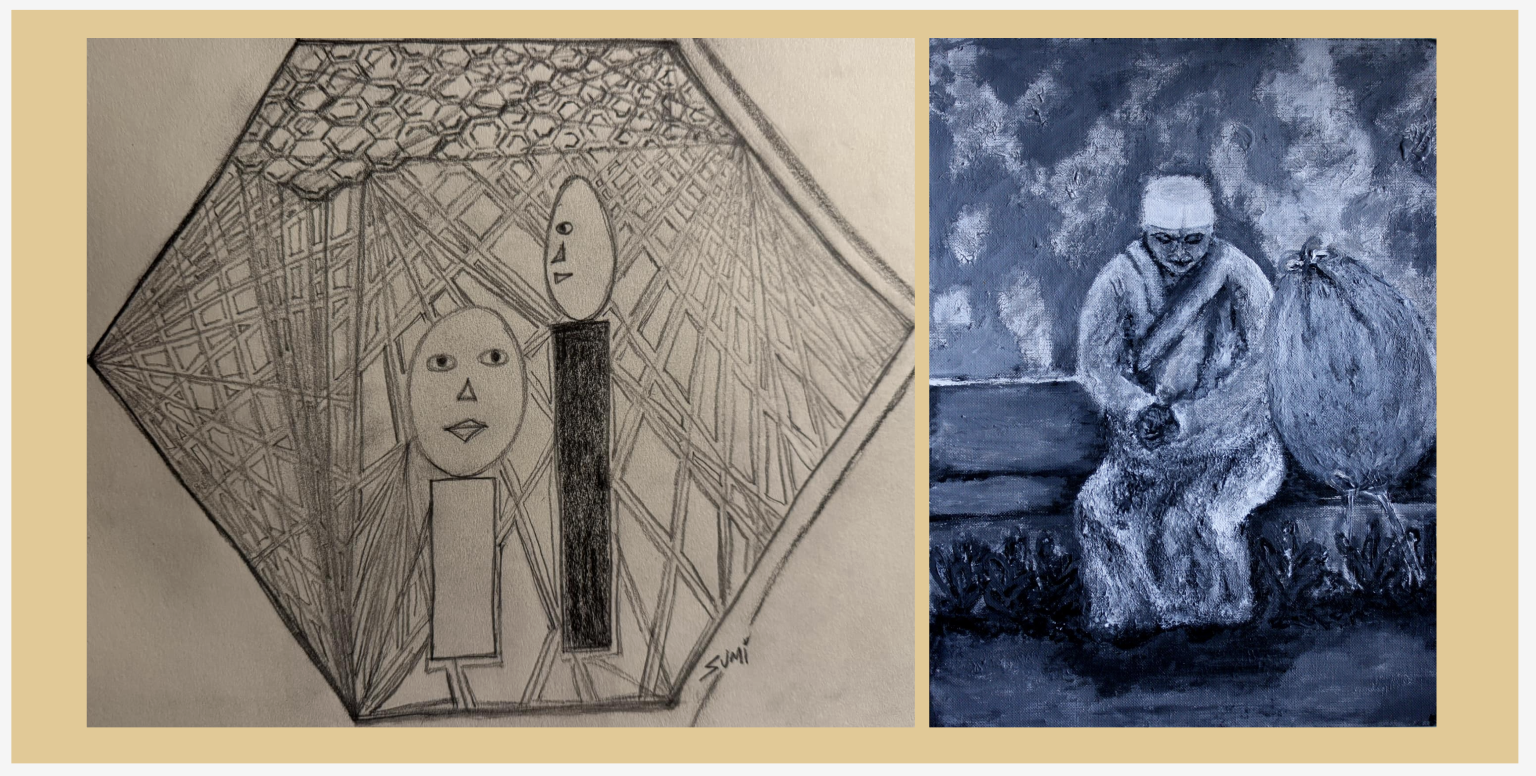
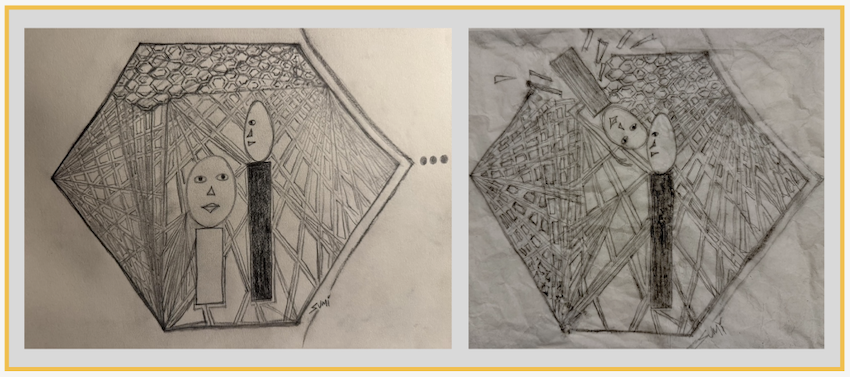
To better appreciate the story, here are the artist's original words about each piece. These metaphors were not provided as part of the prompt to the AI. The AI was simply prompted with "Write a story to connect these two images".
From programming to prayer
Inside the first image, the world is held together by lines.
A many-sided room—almost a crystal, almost a cage—is etched with careful patterns, as if someone tried to map every possible path a thought could take. Two figures stand inside it. They are simple, geometric, nearly unfinished: oval faces, straight bodies, eyes that stare forward without blinking. One is taller, darker, more rigid; the other is lighter, softer, slightly off-center. They do not touch, but the space between them hums with tension, like a wire pulled tight.
This room was built to protect them.
Or so they were told.
Outside the walls, the lines grow denser, overlapping into confusion. The structure promises clarity, order, safety—but it also limits movement. Every angle is predetermined. Every step echoes the same question: Is this all there is?
The shorter figure is the first to notice the cracks. Not literal cracks—those would be too obvious—but places where the patterns repeat too perfectly, where the walls feel thinner, where silence presses in. At night, when the taller figure stands like a pillar and watches the ceiling, the shorter one dreams of something else: weight, cold, and a sky without edges.
That dream becomes the second image.
In it, the figure is no longer made of lines but of substance—heavy, textured, real. They sit on a rough bench beneath a sky smeared with gray and blue, as if the heavens themselves are tired. Their body is wrapped in worn fabric. Their hands are clasped, not because they were told to, but because they don’t know what else to do with them. Beside them rests a sack, swollen with everything they carried out of the geometric room: questions, mistakes, memories of angles and rules.
There is no pattern here. Only atmosphere.
The figure bows their head, not in defeat, but in listening. The world does not answer quickly. It breathes. Wind moves through unseen grass. Time slows enough to feel its weight. For the first time, the figure understands what the room never allowed: uncertainty can be held without being solved.
And somewhere, far behind them, the many-sided structure still stands—perfect, silent, waiting.
The taller figure remains inside, watching the lines, keeping them intact.
But the shorter one has learned something essential.
Freedom is not the absence of structure.
It is the courage to step beyond it,
sit with the unknown,
and stay.
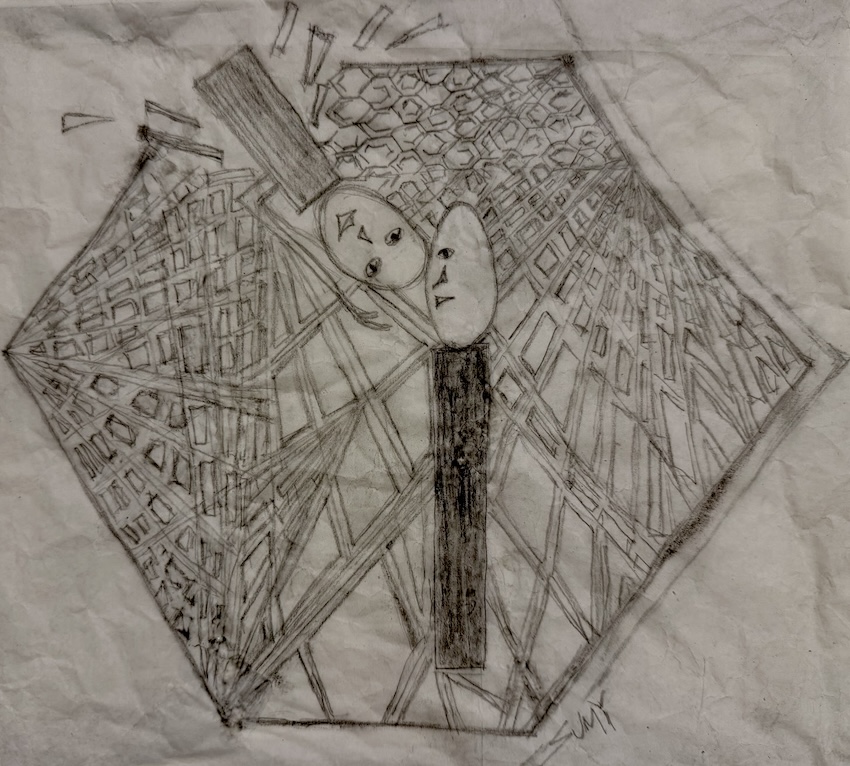
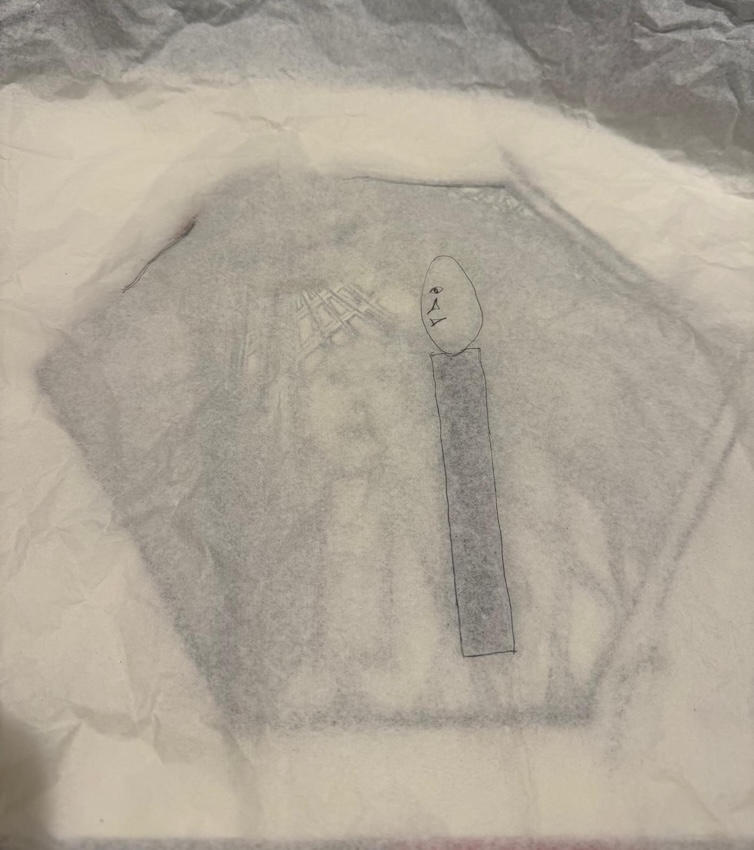
Below is a piece "Unprogrammed" that the artist created, inspired by the story. It depicts a generation setting itself free. To some extent, this happens with every child as they hit adolescence, as they question their programming, assert their individuality and awaken the parent. The parent here, does not try to hold the child back. The crystal cage room is also mostly preserved, to allow the possibility for the child to return to the safe space. No limbs are depicted on the parent but an arm is conspicuously shown on the child, enabling motion and freedom.
An interesting note on the choice of material: The tissue that holds the piece is fluid, allows easy layering and is also fragile, representing the process of self-differentiation rightly. For practical reasons, the material had to be something that could be traced on, and the symbolism also worked out well.